Page: It will do… all the old schmaltz will start happening and you’ve only got the radio station’s to blame for that. I’m going to repeat myself time and time again because I think this is so important – radio stations and rock writers should just give an overall picture of what’s going on, without all these jaded opinions that comes in. All that ‘this is what’s happening man – forget everything else – put them down because this is happening. It’s so wrong man.
RY: The abundance of hype doesn’t help either. Everything that comes out is the greatest new thing since… and that whole trip.
Page: Yeah, you’re right. But I know what my personal record collection consists of, and it’s got just about everything. From ethnic folk music of the aborigines to Mahler. It’s all part of it.
RY: Mahler. That’s interesting. Have you seen the beautiful film, Death In Venice, in which Mahler’s music is featured?
Page: Yeah I did actually. Yeah.
RY: Which records are you playing the most these days?
Page: Page: All sorts of different things. Bert Jansch is often on. Paderewski. No, that hasn’t been on for a while. Lots of early rock… lots of that. All the Sun stuff – it still sends shivers up my spine… it really does. Every now and then, when I’m thinking – you might read a lot… I was going to say when you read a lot of press, you wonder what it’s all about. I stopped reading the press myself, because we were getting things like Melody Maker through the post and it was costing a shilling and it was just total masochism to read it. You know, I was paying a shilling and just torturing myself. So I gave up on all that, and I don’t do it anymore.
Anyway, you put on
something like the early
Presley records and you
hear the phrasing, you hear
the excitement, and everyone’s really into it. At the
end of Mystery Train, you
hear them all laughing —it’s
fantastic. And I can still get
into those records because I
know the excitement and the feeling that was there in those early days when they really knew that they were breaking into something – a new form of music.
RY: There’s a group like that in Canada. It seems that a large number of groups around the world are into rock ‘n’ roll now – Elton John finishes his concerts with a rock medley, Procol Harum also, and so on.
Page: Yeah, it has become a bit of a vogue. Unfortunately too. People like Elton John should leave it well alone, I think personally. It’s very hard, dear me. That’s another story altogether.
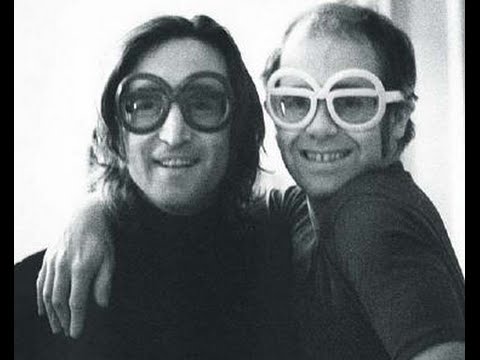
ELTON JOHN
RY: What do you think of Elton John’s albums?
Page: His albums are really, really good. For what he’s doing. I wouldn’t fault them. For his bag. But when he stands up and in sort of a yellow jacket, pink suit, I mean pink trousers, and silver shows, then kicks over his stool, which I thought was an incredible sendup of Jerry Lee Lewis, thinking oh yes, great in crowd humor. Then suddenly you realize that he’s serious and it’s a bit of a comedown after watching all that other stuff.
RY: Are there any new groups emerging in England which have really impressed you?
Page: Yes, quite frankly there are, but my head’s spinning at the moment and I can’t bring anything to mind. If you asked me about American bands, I couldn’t even answer right now.
RY: We were saying earlier that you hadn’t even heard a Grand Funk Railroad album yet?
Page: That wasn’t a put down of the band, it’s just that in England they don’t get played. I’ve heard reports about them, but nothing that would send me to a record shop to buy them on the off chance that they are good. I’ll never do that again anyway with a record. And I advise everybody else to do the same. Never buy a record until you know it’s good. I just seriously and honestly haven’t heard a Grand Funk record. I don’t know what they’re up to or anything.
RY: What sort of things do you have lined up for the immediate future?
Page: I think these home recording studios are going to be a big step towards better things, and technically better things. I hope, for myself, anyway. It’s suicide, I tell you.
RY: Will the fifth Led Zeppelin album be released in a shorted time than the long gap between the third and fourth?
Page: We’ve been recording on and off for a year; not constantly for a year, but every now and again, we’ve said ‘alright, let’s go in and see what we can do’. Every sort of thing seems to be relative statement of what you are at that point… you know, what you’re up to then.
RY: Do you have any problems with old material coming out – I mean, looking back at a certain track and saying that’s not us now… let’s get something together which is where we’re at now.
Page: Yeah, well this is it… you could do that. Obviously one often feels that. But you’ve just got to think it’s a relative statement for the time … at the time it was right… OK fair enough. And what you’ve got to think of all the time is that the next one will be better, better, better. That’s all you can do really.
RY: You’re going to be doing more gigs from now on. Isn’t there an English tour coming up?
Page: Yeah, we had a big sort of discussion about it amongst ourselves, and the idea was just to keep working – doing a couple of dates a week around England so that we’ve never rusty. Because sometimes we’d really knock ourselves out doing five days a week and all that in America, and then going back and really be knackered and have a month off and still be knackered. Then when it came to do a date you’d be rusty and crapping yourself. But now the idea is just to keep it ticking over nicely, and you’re always in trim… you can always keep practising at home and building it all up.
RY: What really happened with that mysterious J. P. Jones album?
Page: That’s quite a long story.
Paul Jones: It certainly is.
Page: You see, there’s this guy in England called John Paul Jones who made an album and tried to trade off our name. Our John spent a lot of time trying to stop it coming out, and in the end they released it under the name J. P. Jones. The next thing we heard was that it was coming out in the States, and we forced them to withdraw it. The strangest thing is that it was on Cotillion label, one of the Atlantic subsidiaries.
RY: That’s strange … Atlantic picking up a record like that when it already had Led Zeppelin selling millions of albums.
Page: Dollars… dollars.
MILAN RIOT
RY: In summary, I wonder if you’d mind telling us what actually went down at that recent concert cum police riot cum war in Milan, Italy?
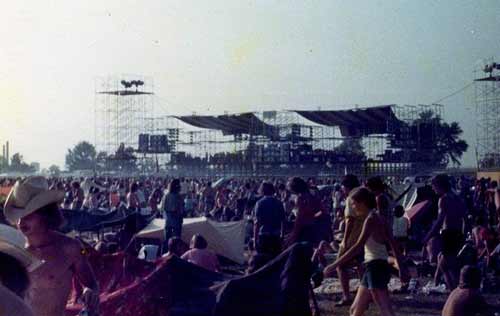
Page: The policing of the people was what initially ruined it. It wasn’t until the brave few rushed forward that things started to happen. But I’ll give you the whole rundown on it. We were playing on the grass in a huge football ground. There were five or six groups before us, and it was sort of a festival thing which had been apparently organized and sponsored b the Government.
We went out on stage an
started playing, and suddenly there was loads of smoking
coming from the back
the oval. The promoter
came out and said tell the
to stop lighting fires. So like twits,, we said into the mikes, ‘Will you stop lighting fires, please. The authorities might make us stop and all that sort of thing. So be cool about it, stop lighting fires, and we’ll carry on playing.’
Anyway, we went on for about another 20 or 30 minutes. Every time they’d stand up for an encore, there’d be lots of smoke. What it really was, as it turned out, was the police firing tear gas into the crowd
We didn’t know at the time – we just kept saying repeatedly ‘would you stop lighting those fires’. Twits, you know.
Paul Jones: The eyes were stinging a bit by then though.
Page: This was it. Until the time when one thing of tear gas caught the stage are – about twenty or thirty feet from the stage – and the wind brought it right over to us… we realized what was going on then.
Paul Jones: We kept on playing though.
Page: Oh we kept on playing. True to the end, the show must go on. But the whole thing was we saw this whole militia as we came into the gig at the beginning, and I said to the: ‘Look this is absurd. Either get them out or get them in trim or there’s gonna be a nasty scene.’ And what’s more, there was a backstage area that seemed to be swamped with everybody. You could hardly move through it, there was so many people. I said if you’re going to have the militia, at least get them to keep the backstage area free.
Well anyway, we were playing and then we said ‘Blow this, it’s got into tear gas. Let’s cut it really short.’ So we did one more number, then we went into Whole Lotta Love, and they all jumped up. At this point, there had been forty or fifty minutes of tear gas coming in and out, lofting about… and somebody threw a bottle up at the police. It was to be expected since the crowd had been bombarded for no reason – for no reason at all. And of course, as soon as the bottle went up, that’s what they’d been waiting for. Whoosh… there it went… all over the grounds – thirty of forty canisters of tear gas all going at noce. This tunnel that we had to escape through was filled with the stuff. It wasn’t done purposely, it’s just the way that things went. It was on another level and we had to run straight through this tear gas to get to the other side, which was a catwalk of rooms.
We didn’t know even then if were going to find chaos on the other side – people panicking and running. WE got in there, and people were trying to get into our door, into our room… probably thinking it was a place that was immune from the rest of it.
Paul Jones: The roadies were carried off in stretchers trying to save the gear. You see, they’d cordoned all the audience right around the back. There was a big line of police holding them there, and the only way they could go was forward, onto the stage. They forced something like 10,000 people up onto the stage.
Page: And our roadies were running around trying to save our instruments.
RY: It’s likely to be a while before you play Italy again?
Page: It’s a word that’s never even mentioned in my hearing. It causes a big argument… or a nervous breakdown.
Paul Jones: It was a war.
Page: Right, it was a war. And to top it all off, after all this, a reporter came back, a guy who’d seen the whole thing and knew exactly what had happened, and knew that the police had started it. He had the cheek, the audacity, to come into the bar where we were resting – we were completely shattered emotionally – he came in and said, ‘what’s your comments about that.’ Of course we just tore him apart, saying ‘C’mon, you saw it… now you write it up… don’t ask our opinion… You’ve got your own.’ But he kept on saying he wanted a comment for us.
RY: Did you give him one?
Page: No. But he almost… he almost had a bottle smashed over his head.